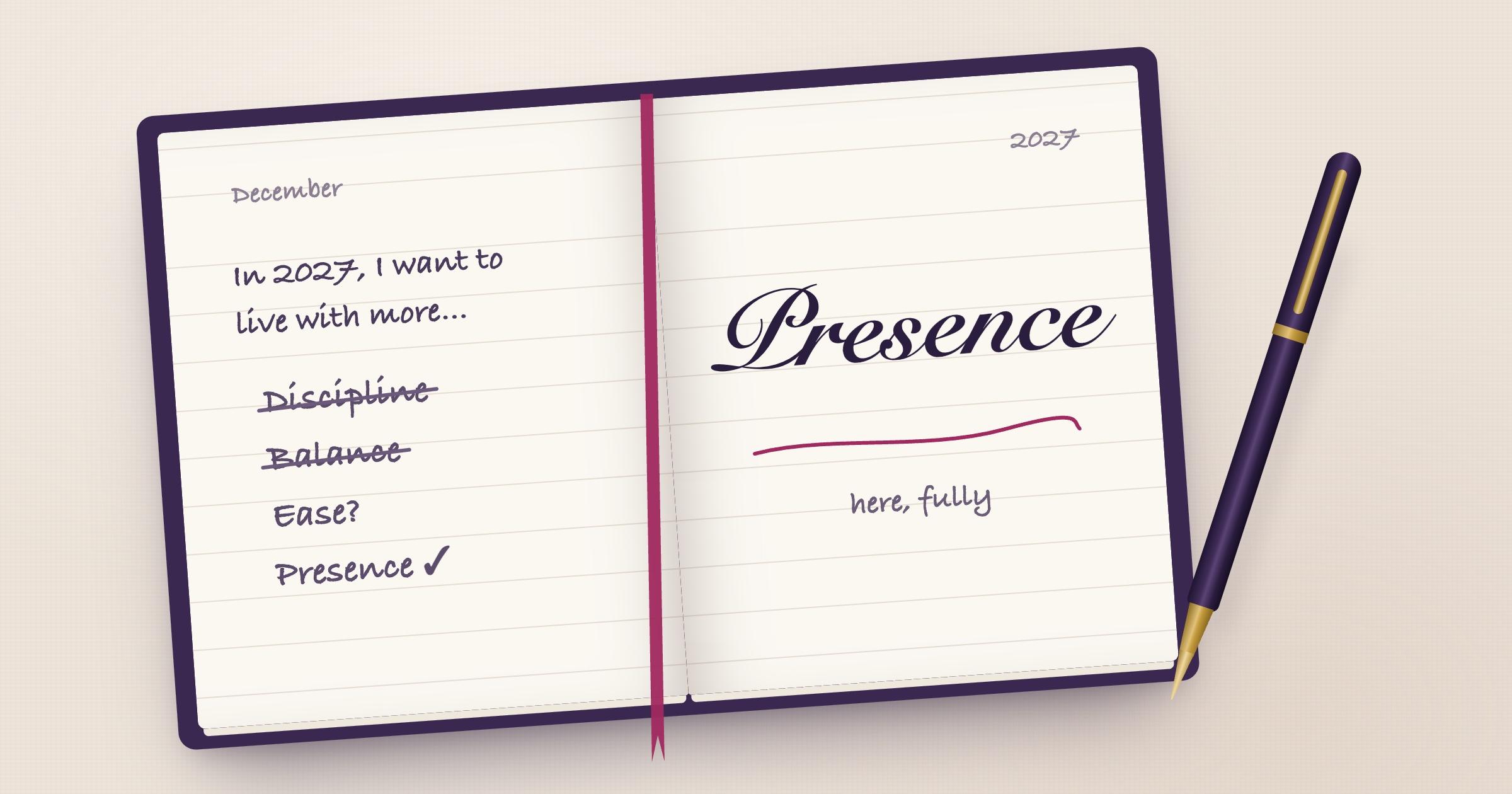
Every December, the same question comes around: what do I want the next year to look like?
You might start with a list of goals, a fresh planner or a vision board full of possibilities. But before you decide what you want to achieve, there’s another question worth sitting with:
How do I actually want to live?
That’s where choosing a word of the year can make a difference. The idea is simple. The challenge is making that word mean something beyond January. Here’s how to choose your word for 2027 and make it part of the life you’re actually living.
What is a word of the year?
A word of the year is a personal guiding word chosen to represent an intention, value or direction for the year ahead. It acts as a reminder of what matters to you and can help you make decisions, recognise opportunities and reconnect with your priorities.
For example:
- Presence might mean putting your phone away when you’re with someone you love.
- Courage might mean having a conversation you’ve been avoiding.
- Expansion might mean making room for experiences that challenge your usual way of living.
- Ease might mean creating more space in your days.
- Connection might mean being more deliberate about the relationships you nurture.
Unlike a New Year’s resolution, your word isn’t something you either achieve or fail at. And unlike a goal, it doesn’t need a finish line. It’s a direction you can keep returning to.
Why choose a word of the year instead of making more resolutions?
New Year’s resolutions tend to focus on outcomes: lose weight, save money, change jobs or learn a new skill. A word of the year starts somewhere different.
Imagine choosing Vitality. It might influence how you approach your health, the friendships you make time for, the work you take on and the experiences you say yes to. It might also help you recognise when you need to slow down.
You can still have goals. Think of your word as the direction and your goals as some of the ways you move towards it.
How to choose your word of the year for 2027
The best word isn’t the one that sounds most impressive on a vision board. It’s the one that feels relevant to your actual life. So rather than starting with a list of words, start with what the past year has shown you.
01 Look back before looking forward
Before deciding what you want from 2027, take a moment to understand what 2026 has been like: not just what you achieved, but what you experienced.
- When did I feel most like myself this year?
- What experiences made me feel genuinely alive?
- What did I do that I’m quietly proud of?
- What did I keep wishing I had more time for?
- Where did I feel disconnected from what mattered to me?
- What am I ready to leave behind?
If you want to explore this further, try these end-of-year reflection questions to help you make sense of the year you’ve had.
Don’t rush to turn your answers into lessons. You might discover that the year was full of achievement but short on connection, or that you spent much of it waiting for the right moment. That can tell you more about the word you need than any list of suggestions.
02 Think about how you want to experience 2027
Now imagine arriving at the end of 2027 feeling that you had lived the year well. What would be different?
- How do I want to feel in my everyday life?
- What do I want to make more room for?
- What would I like to be brave enough to try?
- What do I want to protect, nurture or deepen?
Then try completing this sentence:
In 2027, I want to live with more ______.
Write down whatever comes to mind. Don’t worry about finding the perfect word yet.
03 Explore words that resonate
Look at your reflections and notice the themes emerging. Are you craving more freedom? More stability? More adventure? Sometimes the right word is already somewhere in your answers. These 85 word of the year ideas for 2027 can help you find it.
For courage and new beginnings
- Courage
- Begin
- Bold
- Trust
- Explore
- Unfold
- Leap
- Create
- Risk
- Voice
- Brave
- Initiative
- Possibility
- Reinvention
- Dare
For connection and relationships
- Connection
- Intimacy
- Belonging
- Openness
- Presence
- Community
- Love
- Listening
- Depth
- Together
- Friendship
- Devotion
- Compassion
- Understanding
- Kinship
For calm and balance
- Ease
- Stillness
- Grounded
- Enough
- Rhythm
- Space
- Simplicity
- Restore
- Patience
- Flow
- Acceptance
- Surrender
- Balance
- Gentle
- Breathe
For growth and possibility
- Expand
- Become
- Evolve
- Curiosity
- Discovery
- Flourish
- Potential
- Learn
- Transform
- Bloom
- Stretch
- Renewal
- Emergence
For purpose and direction
- Alignment
- Clarity
- Meaning
- Intention
- Focus
- Integrity
- Choose
- Direction
- Purpose
- Commitment
- Authenticity
- Discernment
- Foundation
For joy and aliveness
- Delight
- Play
- Wonder
- Freedom
- Vitality
- Adventure
- Radiance
- Pleasure
- Celebrate
- Alive
- Joy
- Magic
- Abundance
- Spontaneity
Use these as starting points, not answers. A word you hadn’t considered may feel more meaningful than anything here.
04 Test your shortlist against real life
A word can sound beautiful in theory but feel disconnected from the way you actually want to live. So for each word on your shortlist, ask:
What would this word look like on an ordinary Tuesday?
If your word is Presence, perhaps it means listening without planning your response, enjoying your morning without immediately checking your phone or giving someone your full attention.
If it’s Courage, perhaps it means finally sharing an idea, setting a boundary or doing something before you feel completely ready.
If it’s Ease, perhaps it means not filling every available hour or allowing something to be good enough.
A useful word has room for both the big decisions and the small, ordinary moments. It should feel like something you can live with, not another expectation to meet.
05 Choose a word that invites you, not one that pressures you
There’s a difference between choosing a word because you feel you should and choosing one because something about it draws you in. You might feel you ought to choose Discipline because you haven’t followed through on your plans. But perhaps what you’re really looking for is Trust, Consistency or Self-respect.
Your word doesn’t need to describe everything you want to fix about yourself. Choose one that gives you somewhere meaningful to go, without making your current self feel inadequate. And you don’t need to get it perfect.
How to make your word of the year meaningful beyond January
Choosing a word is the easy part. By February, work gets busy, plans change and the intention you wrote down on New Year’s Day can become another thing you forgot about. The answer isn’t more discipline. It’s connecting your word to the life you’re already living.
01 Give your word a personal meaning
Write a few sentences about what your word means to you and why you chose it. Two people can choose the same word and mean completely different things. For one person, Freedom might mean financial independence. For another, it might mean expressing an unpopular opinion or making decisions without seeking approval.
02 Connect it to different areas of your life
Think about how it might show up in your relationships, work, health, creativity or the way you spend your time. If your word is Connection, you might:
- Make more time for friendships that matter.
- Be more present with your partner or family.
- Join a community that shares your interests.
- Reconnect with something you’ve neglected in yourself.
03 Notice the moments when you’re living it
Your word doesn’t only show up in big milestones. It might appear in a conversation, a decision you made differently or a moment when you chose to slow down.
You can also notice when you move away from it. Not as evidence that you’ve failed: sometimes drifting tells you something important about what you need.
04 Allow your relationship with your word to change
Perhaps you chose Courage because you wanted to take more risks. By the middle of the year, you might discover that courage also means saying no, asking for help or being honest about what isn’t working.
The point isn’t to spend twelve months proving that you chose the right word. It’s to stay curious about what it means as you live.
Your word of the year shouldn’t end with choosing it
Izel follows the same journey as this guide.
Choose. When you start, you choose your Word of the Year.
Live. As the year unfolds, capture your wins, bold moves and reflections by voice or text.
Reflect. Every Sunday, a short reflection brings your week into view, drawing on your own words.
Revisit. Each season, Izel asks whether your word still resonates. You can keep it or choose something new.
Your word is a starting point. Your life is where it becomes meaningful.
30-day free trial. No payment details required.
Frequently asked questions about choosing a word of the year
What is a good word of the year for 2027?
A good word of the year reflects what you want to invite into your life or give more attention to in 2027. Popular choices include Courage, Growth, Presence, Balance, Freedom, Connection, Ease and Purpose. The best word is personal: it should connect to your experiences, values and intentions rather than simply sound inspiring.
How do I choose my word of the year?
Start by reflecting on the year you’ve had. Consider what felt meaningful, what was missing and what you want more of in your everyday life. Identify recurring themes, brainstorm possible words and test each one against real situations. Choose the word that feels most relevant to the way you want to live.
When should I choose my word of the year?
Many people choose their word in December or January as part of their end-of-year reflection and new-year planning. However, there is no fixed deadline. You can choose or revisit a word at any point when you feel ready for a new direction.
Can I have more than one word of the year?
Yes. Some people choose one central word and a few supporting words that help express different parts of their intention. Others prefer to keep one word as a simple guiding theme. There is no universal rule. Choose the approach that feels most meaningful to you.
What is the difference between a word of the year and a New Year’s resolution?
A word of the year is a guiding theme that influences how you want to live, while a New Year’s resolution is usually a specific commitment or outcome you want to achieve. For example, Connection could be your word of the year, while making time for one meaningful conversation each week could be a related goal.
Can I change my word of the year during the year?
Absolutely. Your priorities and circumstances can change. You might discover a deeper meaning in your original word, or realise another word better reflects where you are now. Your word should support your life, not become another obligation.
How do I stay connected to my word throughout the year?
Give your word a personal meaning, connect it to everyday choices and regularly reflect on the moments when you lived it. Recording experiences and revisiting your intentions can help you notice how your relationship with the word evolves over time.